Showing posts with label Irrigation. Show all posts

More old questions answered by new discoveries.

In the last post I talked about the as-built map of the original irrigation system and what a treasure map it seems to be. Pure gold. Maybe it is more of a Rosetta Stone pointing us in the right direction to look for more discoveries. I have had so many questions over 23 years about that old system, the odd layout, the story of the 7th hole. Below are a couple of pictures of what we believe to be the 18 hole routing from Wayne Stiles. His Last. It hangs in the clubhouse. Each hole has two numbers, one is circled. The key reads "circle original 9 built 1936, plain number is what it will become after second 9 is built in 1937", which obviously never happened. Hole #16 is a 400 yd par 4 dogleg left. Exactly what and where I assumed the original 7th hole was. Hole #7 a 185 par 3 using the same green complex. Both are the location discussed in the last post shown on the map labeled "Water Mains & Tree lines". So you can see why I always thought the green was moved from 8 to its current location. The physical evidence of the ground features sure make it seem that it was there. The question now is for how long? On this routing plan there is a yellow line showing that  par 3 fwy. The tee location is about where the current 7 green is located. Similar to the location of the "15th" on this map only opposite direction. The remnants on the ground clearly show a green complex but the new as-built proves that the location was abandoned by December 12, 1938. I always assumed 7 green was much newer say the 1950's. Several things disprove this theory: the as-built map and the aerial photographs posted on Twitter that I was tagged in.  

Picture of the corner of 6,7 8 on same map.
South east corner close up of  1939 aerial


 The other major discovery was the term "fire valve" used all over this as-built. The engineer who is designing the new irrigation system planted a seed saying maybe original owner (Bigelow) was planning a development. I replied that has never been mentioned in our history. Houses came in the 60's as a way to save the course from development. I remembered I had some old maps still in my office so  I rolled one out that was never labeled. It is vintage blue paper and shows a similar 18 hole routing to the one hanging in the clubhouse (the white lines) and clearly shows house lots. Then someone, presumably Stiles, used yellow chalk? to draw yet another alternate routing with house lots. The bell went off. Proof as to why the damn main line was put in so deep (6 feet in most places and 3 where it is in the water table). It always felt like a municipal water system but I never heard anything about houses under the Bigelow regime. I had seen this map a few times but it never clicked what it was until I had the irrigation as-built and followed this train of thought. The map is not named or signed but is clearly vintage. Is it simply Proof positive that Robert Bigelow was at least thinking about housing. Enough so that he installed the irrigation system to double as a water supply system year round.


18 hole routing's with house lots


It sheds some light on the odd rectangular routing that we have and the depth of main line irrigation. It there any way to prove this is Stiles work? Is this just doodles of a landscape architect turned golf course architect? We may never know but it has been fun learning more about our history which all started by the chance gift of the original irrigation as-built.

Happy Birthday- Discovery

This map was delivered to us last week from Antone "Tony" Lima, the grandson and namesake of the Superintendent in the 60's-80's. It is an as-built of the original irrigation system. The first I have ever seen. There is a bit of the "where have you been all my life" feeling. Since we are designing a potential new system it seems a weird twist of fate to finally get my hands on this one. 80 years ago today is the date of this map. Unfortunately it is in really tough shape. We will try to have a copy made but I do not have high hopes. I have taken some pictures of it and will do more in the near future. One major discovery is the location of the 7th hole. You see, all the other maps I have seen show the 7th as a dog leg left par 4 with the green in the location of the forward tee on 8.


"Water Supply System Dec 12 1938"
7 in it's current location


1938 July "Water Mains & Tree Lines"

I have showed tons of people the remnants of what sure look to be a green complex with bunkers. Even the architects I have shown agree it sure seems like it. So was it roughed out only? Seeded and then moved? No one has ever been able to tell me they remember the green anywhere other than where it is now and this new map sure as heck proves it was, as of Dec 1938 at least. But what about the features on the ground on 8? The mystery of the 7th continues.

Below are a couple of pictures of the pond off the parking lot. One is looking East at sunset and it looks more like a sunrise with the water on fire. the other is today with a skim of ice holding the dusting of snow we received. It did not settle on the grass and we had a golfer enjoy the day. Winter on Martha's Vineyard

fire and water
ice and snow

Quite a stretch

That was one of the most brutal stretches of weather we have all seen here on MV. Dog days for sure. I have heard more times than I can remember "we never needed air conditioning on MV" or "we only get a few days of really hot weather". That stretch broke all time records for Providence, RI. It was unbearably humid for roughly 6 weeks straight. We may not have had peak high temps but it was really hot and just unpleasant for man, or beast and especially cool season turf. The disease pressure was through the roof and we saw active fungus many times. The picture below shows the tee which is sprayed conventionally holding up nicely. The rough at the beginning of the fairway which gets sprayed with the Bioject (natural bacteria that we brew and spray instead of synthetic fungicides) also doing well. And in between a swath of unprotected rough that looks as if it has an inch of snow on it. The white mycelium of the Dollar Spot fungus means it is active and spreading. After the mycelium goes away it leaves a bleached lesion on the leaf. if enough damage is done the grass will take on a tan hue. hopefully that will be the end of that weather and we can continue into cooler nights and the turf can begin to recover from all the damage. Maybe we can all turn off our air conditioners too.

active disease

Disease lesions

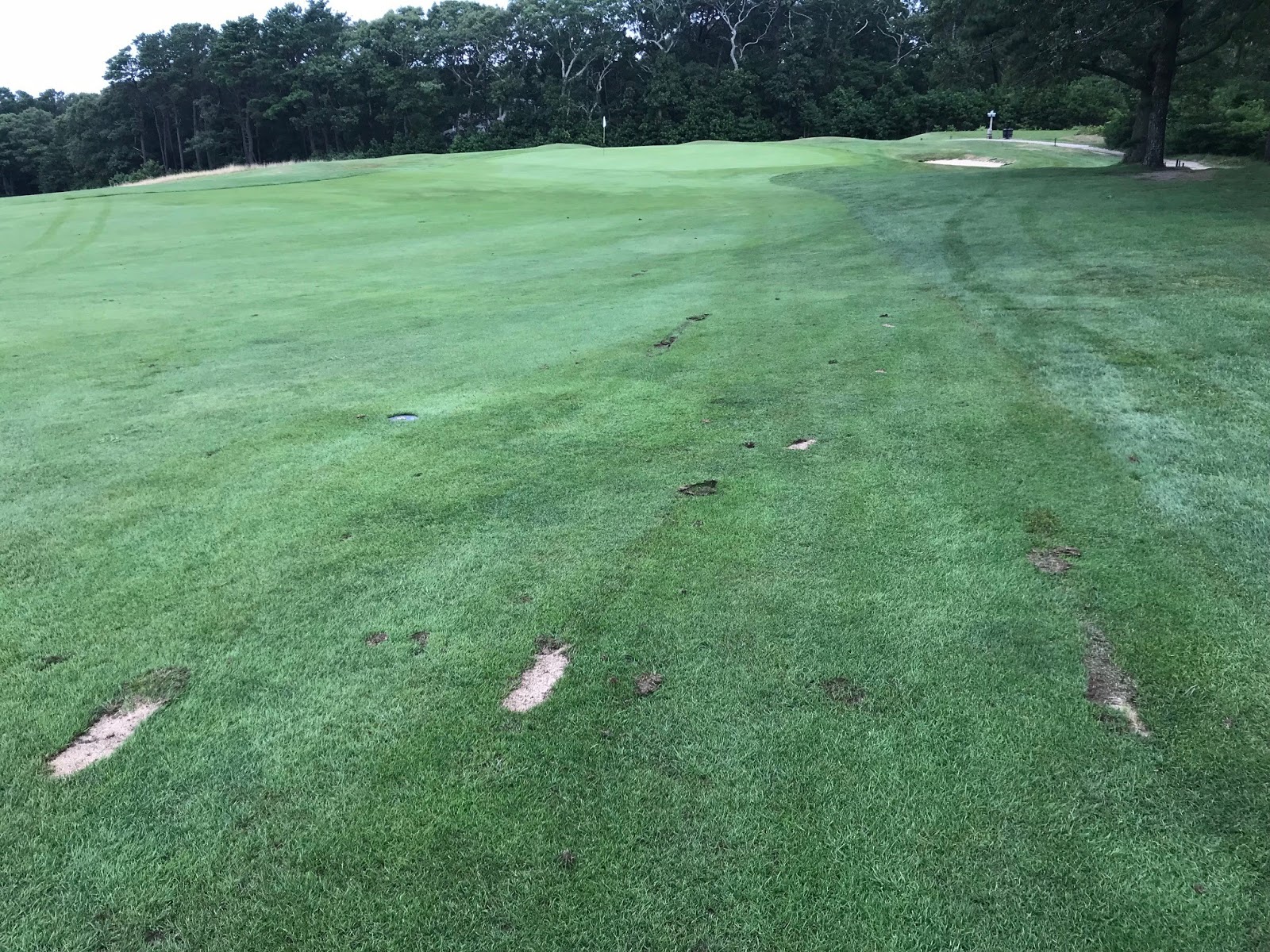
Speaking of damage. Our salt water intrusion was high again this summer and it shows by how slimy the soils are. Think of a pile of ice melt spilled on the driveway or the salt in your shaker. The salt builds up and then pulls moisture out of the air keeping the surface moist and soft. This means it is easier to take a divot and in some areas the turf will simply peel up from any aggressive cart traffic. Please use caution with carts and try to avoid excessive turning and driving around until we can flush the salts from the surface. I will apply a gypsum application which will help with the flush.

Small Tire skid

Large Tire skid
cart damage 8 fairway
The fairways may be soft making it easy to take divots. I can handle a few extra divots there. What tests my patience at the end of a tough summer is divots on greens. There is simply no reason to take a divot on a green. We had three in about a weeks time. Same person? There is no way of knowing who the culprit is unless someone tells us. Obviously they suck at putting and have anger management issues or simply have no clue how to play the game. I often say the etiquette of the game is gone. These episodes only reinforce that thinking. If you play with someone who does this please tell them how bad it is and let us know who they are so we can reinforce the message.

divot 5 green

divot 6 green
With the change to our schedule moving the club championship to september we lose the ability to do our normal greens aerification the day after Labor Day. We will however try to do a needle tine aerification a couple of times this fall. We may even vertical mow and topdress the greens so keep an eye on the schedule for some minor disruptions to the tee sheet over the next few weeks.


Pretty clouds

Fall Season

I cannot believe it has been almost a month since the last post. September has flown by or maybe blown by as the latest storm is upon us as I write this. We have had our share of massive storms this season luckily down south and not up here but our thoughts and prayers should be for those affected. The Caribbean has been devastated and parts of this country have had their issues as well. We are no stranger to wind, rain, and tide damage on MV but hopefully these big storms do not add up to much more than the typical Nor Easters we get.

I went through my phone camera for some of the highlights of the last month:

4th tee before thunderstorm shut us down
almost finished

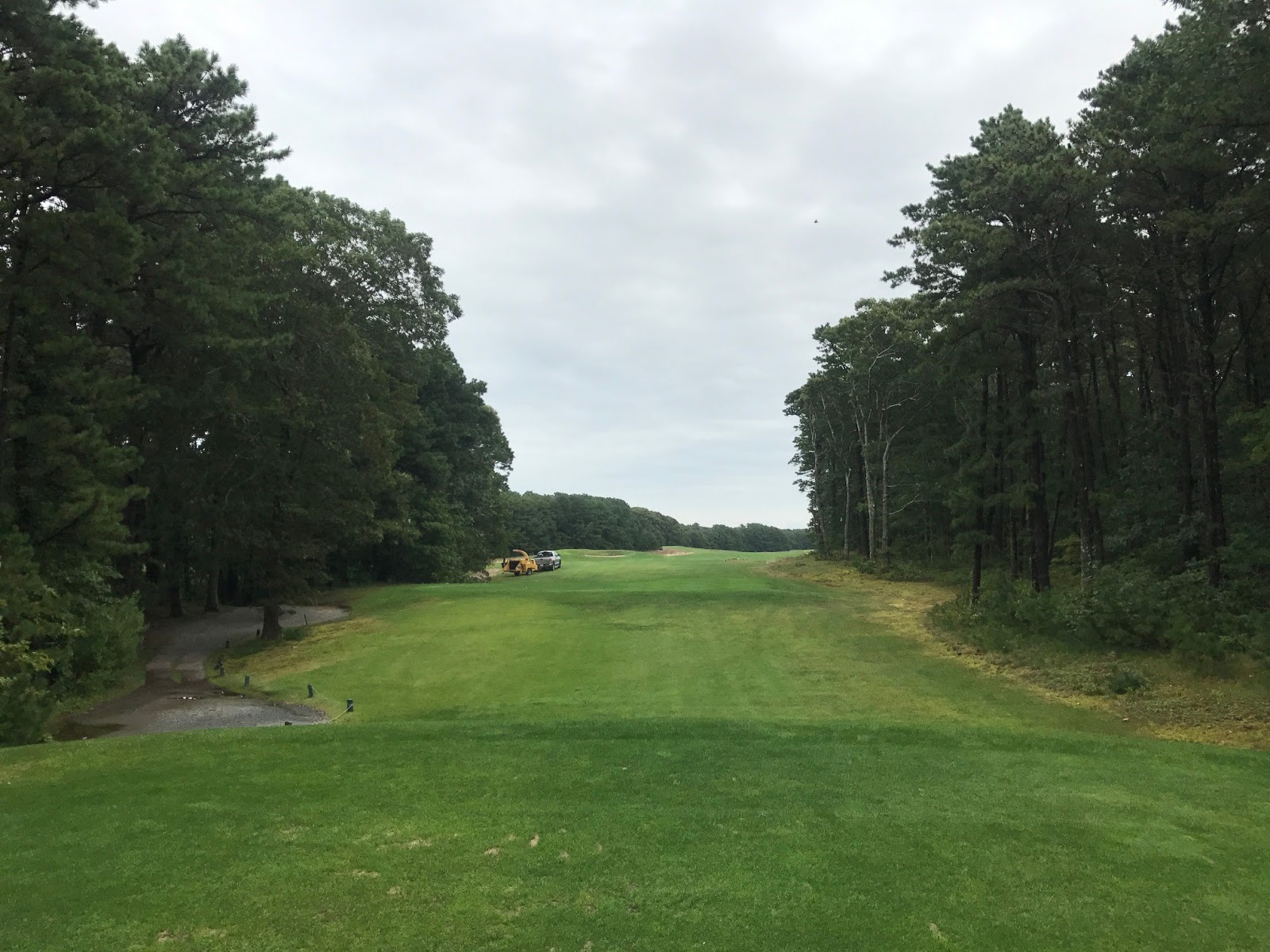
The trees had started to creep in on both sides of the 4th tees. From the back tee it was becoming a shoot only a PGA Tour player could get through without clipping a branch. Our tree company was going to be at a neighbor's house so we scheduled to sneak them in with the lift to open this area back up.


Every year the trees grow taller and wider. We need to keep in mind that the playability of the course should be our priority. If allowed, the forest would close in and take over. Trees need to be pruned and even removed to keep the course design and integrity intact. This includes shrubs planted as distance markers that now have become full size trees and may be a hindrance to play. They certainly have no distance function anymore as everyone has some electronic device to tell them distance, wind speed, elevation, temperature of the water coming out of the fountains etc.

Fun with fescue mowing
I started to mow some tall grass areas in preparation of the Bass Ackwards. Chris Morse was playing and mouthed to me "can't you leave some?" as he walked by. I too like the definition the tall grass areas give the course but as I posted here mid-summer, this year it is so thick it is unplayable. I started mowing a labyrinth pattern and probably should have left it for a couple of weeks. I found an irrigation leak on the hill so became distracted and decided to mow it all before we fixed the leak. 
Tall grass leak, Bert supervising Murph's glue job.
break at the test head. no thrust block on original. Bag of cement this time

Rotted nipple on 3 and end of a wire spool
The bad luck of irrigation breaks came in 3's with the last being on the 3rd hole. Luckily we caught this one before it was a major blow out. It certainly was ready. We discovered a massive amount of extra wire in the ground. Our guess was they were at the end of the spool so simply hooked it up and buried it. This is never a good idea since while digging up the head it is hard enough to avoid hitting the regular amount of wires in the ground. We cut it out when making the repair. Every hole is an adventure. 
Lastly, I had the pleasure of playing golf with the President of GCSAA Bill Maynard, CGCS. He was invited to celebrate the 50th anniversary of the Golf Course Superintendents Association of Cape Cod. We were originally slated to host the Sept meeting but it became the perfect month to have this celebration and New Seabury volunteered. We do not have the facilities and as luck would have it I heard they were the first location 50 years ago. It was a perfect day and the current board did a great job with lots of memorabilia, a slide show of historic pictures, 50th pin presentations and great gifts. The foursome pictured is Bill, Brian Smoot, President GCSACC, Paul Doherty, Past Pres. GCSACC, and me Way past president GCSACC.
GCSACC.org turns 50

Spring- officially here & chasing a leak underground

They are Back!
Well it is official, Spring is here because OUR osprey is back. Who cares about Belle? Actually it has been great to watch her progress, as of yesterday she was in CT. Ours was spotted yesterday as he/she flew right over the maintenance building. One of my favorite osprey memories is watching one fly into a dead tree right next to the shop trying to break off a branch to add to the nest. It was impressive.

Murph mowing greens for second time this week
The season has officially begun in my opinion because we started mowing. We tried an official "opening day" once but it really does not work when you are open all the time. There is something special when the greens get mowed and start to look and feel like greens again. We mowed Monday, then rolled Tuesday and then mowed again Thursday. I applied the Spring seed head suppression application. This product keeps the annual bluegrass (Poa Annua) from seeding. This will keep the greens smoother through the seeding process. As we convert the greens to more and more bentgrass this application will change to a Poa killing application. Well maybe not killing but certainly one which will put a severe hurting on it. Right now we still have a bit too much to take such extreme measures. The next post will explain how this product works and show some of the test plots we have set up to test the effectiveness and best timing for it.

Finally
With an 81 year old irrigation system that has main lines about 6 feet deep there are bound to be issues right? One of the main issues is that we drain really well and if there is a small leak we never know where it is. We have a small submersible pump in a small well that maintains the pressure in the system, 115 psi for those interested. For context the pressure on municipal water supply to your residence is 40-70 psi. We live and die by the cycle of this pressure maintenance pump (pm pump, or pm cycle). It tells us how tight the system is and whether or not we have any leaks and how bad. The pumps have settings for major blow outs and will hopefully shut down before doing extreme damage to the ground around the break but for smaller leaks they do not know the difference between that and us watering. Hence the reliance on the pm cycle. Historically we start the season in the high 20's and eventually settle out in the mid teens. Murph and I look at this cycle constantly. It is usually the first thing I do when I wake up, checking the irrigation system to see what kind of day I will be in for. We live every day waiting for failure due to the age of the system. 

I can honestly say this is the most excited I have been for a leak


Well, last Fall the pm cycle dropped to 4 minutes for weeks on end. We drove around and around looking for weepy heads and leaking pipes to no avail. We came up with a plan to open the system in small stages hoping to pinpoint the leak. This never really came to fruition since a couple of the fairway valves would not hold and filled with water against our best efforts. The newer system from the 90's is plastic and really the worst part of our system or the part that gives us the most trouble. The glued joints on this system are starting to fail and there are literally thousands of them so our worry was that maybe we do not have one big break on abandoned galvanized pipe down deep but many small leaks on plastic all over. After 4 days of tinkering with the system partially filled up, at an increased pressure of  120, the leak finally improved enough to show itself. I can honestly say this is the most excited I have been for a leak. At least I can stop worrying about where and when and whether the pm pump is going to burn up from such a short cycle.  


With a big storm predicted for today and tomorrow the sunrise was really good. Cheryl took these above. Mine are below and were too early and I was already off to work when it peaked.


September at last. Careful what you wish for...

The last 24 hours finally felt as if we have made a turn in the weather. It has been one heck of a hot and dry summer. The showers yesterday were just perfect as soft gentle rain. We received .18" over a few hours. 5 more days of that and we will be in business. Add to that the nice cool temperatures of 64 this morning and we have ourselves some happy cool season turf. Sadly we cannot always get precipitation when and how we want it and the forecast for the weekend does not look great. I guess our streak of perfect golf weather may be over. If all we end up with during this hurricane season is rain I for one will be pleased. Wind an all that comes with it is never any fun. Besides who could hate a storm named Hermine? She was one of my favorite Harry Potter characters.

photo from Facebook


1st green Thursday afternoon

Interesting colored dragonfly
Salt damage on vegetation
The one good thing about heavy rains is the flushing aspect. The salt levels in our irrigation well have been very high lately as evidenced by the damage to the trees (see picture above). It builds up in the soils and wreaks havoc on grass roots as well. Hopefully any rain will help flush some of those salts away and we can begin our road to recovery in the areas most affected by the drought.

sunrise 1st Green

Catching up

I started this post a few weeks ago and still never found the time, or interest I guess, to complete it. As a follow up to the last post outlining the drought we are in I will give a few more facts and figures. The first picture is one I saw on Twitter. The numbers are from June 1 to August 31 and were posted on 8/6, I believe. We have all seen some rain since then so the graph is not current but still relevant.


Our own number to compare with this graph is 5.94" The day after the last post (7/23) talking about the drought and posting our local records we received  3.19". See the radar of that storm below and notice the white dot amongst the purple cells. Red on the radar is scary enough. To have received only rain and not massive wind or lightning damage with purple and white is lucky indeed. The rain was a blessing but the numbers become skewed. Most of that type of rain simply runs off and its greatest benefit would be to fill a pond, if we had one. The point is prior to this storm we were at 2.75" compared to the 3.02" in the graph so our deficit is still quite real. The few rain events we received were helpful and the only reason we are not in the same drought category as Boston.

massive storm in july. we are just east of the white cell
irrigation leak on abandoned galvanized pipe attached to 1936 main line
All things considered the course and staff had held up well. We had a visit from President Obama, our first in a couple of years. He even played 18 holes, a first. The crowds are starting to dwindle much like the amount of daylight. We notice it since we start so early that what we were able to accomplish with good visibility just a few weeks ago are now being done in the dark. I assume cooler temperatures and lots of precipitation are also in our near future. Both will be a welcome change.

POTUS and Ray Allen. adding up the scores

Drought: by the numbers

3rd hole

2nd hole Mother and babies
The course is starting to show the signs of the weather we have been having. I put together a couple of pictures to illustrate the data. The first shows the last four years of local rain totals from the weather station on the gazebo with a 21 year average. I arrived in the Fall of 1995 and starting tracking with a manual gauge before we purchased the station. The monthly totals are always interesting but do not show the entire picture sometimes so the second sheet is directly from the weather station.


The second graphic shows the daily data. I highlighted with red arrows any rain event over two tenths of an inch. I labeled it .1" but a tenth is a drop in the bucket once you are dry. Since May 13th there have been 5 events. They were fairly well spaced out and each was a life saver when they came. The rule of thumb for irrigation or rainfall for cool season turf is 1-1.5 inches per week. Our rainfall came about every two weeks and none of them were even 1 inch so that spells deficit right there. We make up the difference with irrigation but as the pictures of the course at the beginning of this post show the system does not have perfect coverage. If we use the conservative number of 1" per week and the picture highlights 10 weeks and we have only received 3.6" the deficit is 6.4". Simple math right? Unfortunately grass doesn't do math. Once the ground is extremely dry the water just runs off and does not penetrate. We could get all 6.4" tonight in a Thunderstorm but most of it would run off and flood the low areas. The one thing data and experience has taught me is that the average for the year is pretty consistent, so eventually it will rain again. Meanwhile we just have to enjoy the different colors, textures, bounces and lies this weather pattern has created on the links.

6th hole

Fire in the sky


Great Winter Weather

I saw a graphic on Twitter from the National Weather Service comparing the weather from Dec and now. The parallels were uncanny which did not need explaining to anyone here since we are living through this miserable weather. I cannot believe it has been 3 weeks since the last update. We have obviously been busy prepping the course for the season. Lots of irrigation repairs, a bit of tree work, we even managed a deep tine aerification on the greens. It continues to be cold and rainy. Since March 1st we have received 11.44" with 1.83" in the last 5 days alone. The course has taken it and remains quite playable. The leaves are starting to pop on the trees and more golfers are appearing every week. Some of the highlights from the last 3 weeks are below:

Fairway Fred Pekari turned 80 so we threw him a party

aerified shallow pipe the installers laid on a boulder

more shallow pipe they pulled over a pile of rocks

watering in topdressing after aerifying. Only did it once then it rained every day since
one of many dead oaks Will cut down

tournament Sunday had an amazing sunrise